/images/avatar.png

Xiaopeng Xu, Ph.D.

Research Scientist @ KAUST · Agentic AI for scientific discovery, protein design & synthetic biology

Recent News

  • Sep 23, 2026, my Co-I Shaheen III Grand Challenge Project proposal on “Multi-Scale AI-MD-QM/MM Platform for Next-Generation Biologics Design” was appproved on Shaheen III GPU! Cheers!
  • Aug 2, 2026, my Co-I Translational Research Grants (TRG2026) on AI-based protein design solutions for industrial biologics and medical applications was funded by KAUST! ~1 million USD fund to support our research! Cheers!
  • Jun 23, 2026, started as a Research Scientist at SFB@KAUST.
  • Jun 8, 2026, Mater-trends — to track researches on material science — up and alive.
  • Jun 3, 2026, AI-trends — to track research trends on artificial intelligence — and Bio-trends — to track researches on bioscience — up and alive.
  • Mar 25, 2026, the first tool buddle in MacromNex, ProteinMCP — an agentic AI framework for autonomous protein engineering, published in Protein Science!
  • Mar 24, 2026, SegDesign — a framework for protein segment engineering — published in Protein Science.
  • Jan 22, 2025, AggNet — a Deep Learning method for protein aggregation prediction — published in Protein Science.
  • Oct 3, 2024, AutoBA — for multi-omics analysis with Agentic AI — published in Advanced Science.
  • Jul 18, 2024, SANTO — a method for alignment and stitching in spatial omics — published in Nature Communications.
  • Jun 12, 2024, HELM-GPT — de novo macrocyclic peptide design — published in Bioinformatics!
  • Jun 23, 2024, started as a Postdoctorate Research Fellow at SFB@KAUST.
  • May 13, 2024, my Co-I Shaheen III proposal on “Molecular dynamics simulations-enhanced AI for enzyme design and optimization” was appproved on Shaheen III CPU! Cheers!
  • May 5, 2024, defended my Ph.D Dissertation — “A ChatGPT-like solution for protein design: combining generative and predictive AI to design functional proteins”! Cheers!
  • Jun 28, 2023, SGPT-RL — for chemical drug design with GPT and RL — published in F1000Research!
  • Feb 20, 2023, AB-Gen — for antibody with GPT and RL — published in Genomics, Proteomics & Bioinformatics!
  • Nov 11, 2021, an AI guided review of 17 000 studies in COVID-19 computational research published in Briefings in Bioinformatics

Recent Notes

R 常用命令

基础操作

包操作

install.packages("ggplot2") # 安装包
library(ggplot2) # 加载包

R notebook 快捷键

Ctrl+Shift+Enter # Run current chunk
Ctrl+Cmd+I # insert new chunk
Ctrl+Shift+K # Preview HTML file

更改当前目录

setwd("/path/to/my/directory")

赋值

inoutpath <- "datanew"
a = 123
fetchScholarAuthors <- T # T for True
errToFile <- F # F for False

数据操作

读取数据

train_10_scores = read.csv("result/train_10k_scores.csv")

合并 dataframe

library(gdata)
density_dat = combine(Train, Prior) # 合并后会新增 source 列,对应 Train 和 Prior

ggplot2 绘图

线图

ggplot(NULL, aes(x, y)) +  geom_line(data = data2, col = "blue") + 
labs(x="X axis", y = "Y axis") # Rename axis

点图

ggplot(NULL, aes(x, y)) +  geom_point(data = data1, col = "red")

Histogram 分布图

ggplot(df_sample, aes(x=dist, colour=source, fill=source)) +  # 设置底图和数据
geom_histogram(alpha=0.3, binwidth=1) +  # 画 histogram 图
coord_cartesian(xlim=c(0, 15)) + # 设置作图区间
labs(x="Paire-wise distance") + # 设置 x-轴名称
theme_bw() # 设置白底

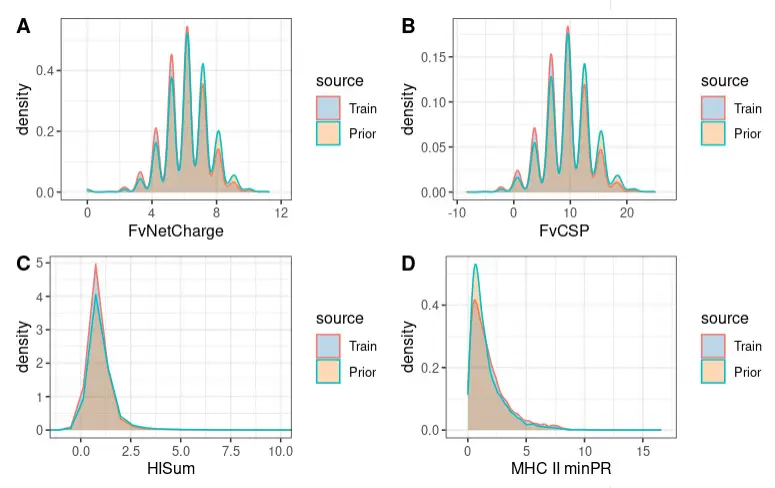
Density 密度分布图

cols <- c("#1f77b4", "#ff7f0e") #, "#72D8FF")
ggplot(density_dat, aes(x=raw_FvNetCharge, colour= source, fill= source)) +  # 设置底图和数据
geom_density(alpha = 0.3) + # 画 density 图
scale_fill_manual(values=cols) + # 对下方区间染色
theme_bw() # 背景色设为白色

合并多张图

# bxp <- ggplot(...)...
# dp <- ggplot(...)...
# lp <- ggplot(...)...

figure <- ggarrange(bxp, dp, lp,
                    labels = c("A", "B", "C"),
                    ncol = 2, nrow = 2)
figure
https://xux-zotero-img.oss-cn-beijing.aliyuncs.com/img/20260613004628911.webp

Huggingface Transformer

什么是 Huggingface?

一个专门 AI 公司,维护了 python 的 transformer 库。

Transformer 介绍

https://xux-zotero-img.oss-cn-beijing.aliyuncs.com/img/20260613014626367.png

什么是 NLP?

以下是常见 NLP 任务的列表,每个任务都有一些示例:

  • 对整个句子进行分类:获取评论的情绪,检测电子邮件是否为垃圾邮件,确定句子在语法上是否正确或两个句子在逻辑上是否相关

药物设计笔记

导论

概述

创新药物发现—从基因到药物

https://xux-zotero-img.oss-cn-beijing.aliyuncs.com/img/20260613031127380.png

药物 R&D

https://xux-zotero-img.oss-cn-beijing.aliyuncs.com/img/20260613031130004.png

药物设计 3W

  • Why?

    • Unmet medical needs

    • Time-scale

    • Success rate

  • What?

    • Disease mechanism-Target identification & validation

    • Lead generation

    • Lead optimization

  • How?

    • Drug Design –The application of CADD in drug design

    • Bioinformatics, proteomics, Combi Chem/HTS

    • Target-drug interaction mode

    • Early ADME/T evaluation

药物设计内涵:药物研究模式的转变

https://xux-zotero-img.oss-cn-beijing.aliyuncs.com/img/20260613031132901.png Lee JA, Berg EL. J Biomol Screen. 2013 Dec;18(10):1143-55

SMILES 化学表示

参考:

简介

SMILES,全称是 Simplified Molecular Input Line Entry System,是一种用于输入和表示分子反应的线性符号。

示例

下面看一些例子: