 Xiaopeng Xu
基于结构设计抗体
总体介绍
目前抗体圈主要是在英美。美国以 RosettaCommons 为核心,有好多人在做抗体设计。英国以 Oxford 的 Charlotte Deane 为代表,有很多研究人员做此方向。
Rosetta 目前被蛋白质设计相关组广为使用。主要是美国的一些科研机构在用。包含抗体序列numbering、抗体结构预测、抗体抗原 docking 和 抗体设计等项目的多个软件。Numbering 主要用的是 PyIgClassify (2015), 抗体结构预测包括 RosettaAntibody(2009), AbPredict (2016, 2019), 和 RosettaCM (2013),抗体抗原 docking 包括 RosettaDock (2008) 和 *SnugDock(2010),抗体设计包括 RosettaAntibodyDesign (RAbD, 2018) 和 AbDesign (2015),通过引用量来看 RosettaCM (748),RosettaAntibody (2009, 175),RosettaDock (2008, 516) 和 SnugDock (2010, 122) 用的人较多。另外,Rosetta 有个在线平台 Rosie,提供在线服务,做蛋白质结构预测和 Docking 等,https://rosie.rosettacommons.org/queue。
以 DeepMind、Oxford 的 Charlotte Deane 为代表的英国很多机构和研究者也在做相关领域。其中, Charlotte Deane 开发了许多软件,用于做抗体结构相关分析。包括做 Numbering 的 ANARCI (2016, 124),做结构预测的 AbodyBuilder (2016, 87),做 cdr loop 区域预测的 ABlooper (2021, 1)。
下载安装 Rosetta 系列
从 https://www.rosettacommons.org/software/license-and-download 注册申请 license,并下载对应的 src 压缩文件。
压缩包下载后,用 gunzip 解压。可以调整解压后文件的目录的名称位置。然后进入 main/source 目录,进行 build。build 好后,将下面的 bin/ 和 tools/ 目录加入 PATH 环境变量。
gunzip rosetta_src_3.13_bundle.tgz
mv rosetta_src_3.13_bundle rosetta_v3.13
cd rosetta_v3.13/main/source
# build
./scons.py -j 100 mode=release bin
# -j 100 define the number of cores to run.

# add environment variable
export ROSETTA_PATH=~/Desktop/Ab_design/ref_works/Rosetta/rosetta_v3.13/main/
抗体结构预测
目前看到有两种方法比较适合有模板的抗体结构预测问题, RosettaAntibody 和 AbPredict。
RosettaAntibody 使用
ROSIE 平台任务提交入口:https://rosie.rosettacommons.org/antibody/submit
输入是 Fv 两个 chain 的序列的 fasta 文件。同时需要选择 graft 的 database 以及 blastp。
安装依赖项
blastp 按照 blast 官方说明,下载源码并 build 即可,无需下载数据库。https://blast.ncbi.nlm.nih.gov/Blast.cgi?PAGE_TYPE=BlastDocs&DOC_TYPE=Download.
运行代码
$ROSETTA_PATH/source/bin/antibody.linuxgccrelease -fasta 4m5y_Fv.fasta -antibody::grafting_database $ROSETTA_PATH/database/additional_protocol_data/antibody -antibody:n_multi_templates 1 -exclude_pdbs 4m5y -antibody::blastp /home/xiaopeng/Desktop/Ab_design/Rosetta/blast-2.12.0/c++/ReleaseMT/bin/blastp用 pymol 查看生成的模型
pymol grafting/model-0.relaxed.pdb

# Input in pymol command line
fetch 4m5y  # fetch 4m5y as framework to compare
alignto  # alignto 4m5y for close comparison
识别结构的 CDR loop 类别,即 North cluster
$ROSETTA_PATH/source/bin/identify_cdr_clusters.linuxgccrelease -s grafting/model-0.relaxed.pdb -out:file:score_only north_clusters.logNorth B, Lehmann A, Dunbrack RL. A new clustering of antibody CDR loop conformations. J Mol Biol 2011; 406:228-256.
Ablooper 使用
使用 Ablooper 需要先获得蛋白结构,默认推荐用 AbodyBuilder 来预测结构。
ABlooper, a fast equivariant neural network for predicting CDR loop structures [1].
创建基础模型
先用 AbodyBuilder 创建抗体模型,如下 web 页面所述。输入是 Fv 两个 chain 的序列。
http://opig.stats.ox.ac.uk/webapps/newsabdab/sabpred/abodybuilder/
用 AbodyBuilder 预测出的结构有些位置不太准确,差异较大。与 ref 对比: RMSD=0.353。
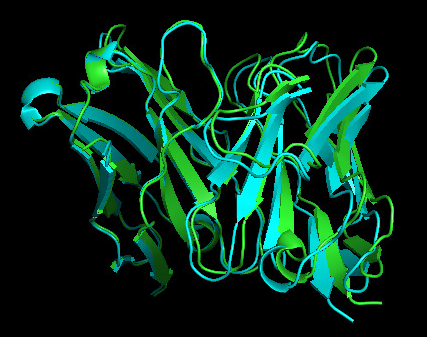
使用 ABlooper 预测 CDR loop 区域
输入是用 IMGT numbering 的 pdb 文件。AbodyBuilder 输出可满足。
# 需在 python2 安装 biopython 依赖包
ABlooper Test_fv_model_rank1_imgt_scheme.pdb --output ABlooper_model.pdb --heavy_chain H --light_chain L
预测出的结构和 AbodyBuilder 差不多,但是有些区域的精度 (temperature) 比较差。官方文档说可以用 Rosetta 优化。与 ref 对比: RMSD=0.353。
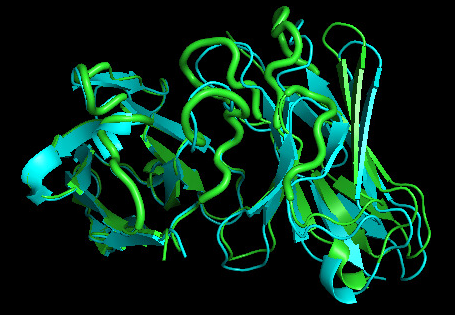
使用 ABlooper 优化预测精度
默认 Ablooper 输出的模型精度较差。可以用 PyRosetta 来优化精度。
安装 PyRosetta
获取 license:https://www.rosettacommons.org/software/license-and-download
下载 zip 文件包,见 https://www.pyrosetta.org/downloads#h.abjy686qantw 说明。
打开 conda 环境,解压并用 安装 pyRosetta。
conda activate ab-env # 激活环境
# 安装 pyRosetta
cd setup
python setup.py install
# 在 python 命令行中,测试是否正确安装
>>> import pyrosetta
>>> pyrosetta.init()
更多 PyRosetta 介绍见:https://new.rosettacommons.org/docs/latest/scripting_documentation/PyRosetta/PyRosetta。
运行 ABlooper 优化
# 运行 ABlooper 优化
ABlooper ABlooper_model.pdb --output ABlooper_model_opt.pdb --side_chains
优化后,预测出的结构和解析出的结构已经极为相似了。与 ref 对比:RMSD = 0.391。
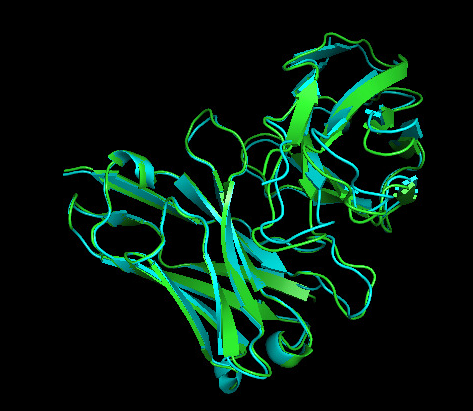
抗体抗原 dock
目前看到有两种方法比较适合抗体抗原 Docking,即 RosettaDock 和 SnugDock。看的也有用 zDock 的。
RosettaDock 使用
安装依赖包
# 需在 python2 安装 biopython 依赖包
sudo apt-get install python2
sudo apt-get install python-dev
wget https://bootstrap.pypa.io/pip/2.7/get-pip.py
sudo python2 get-pip.py
pip2 install biopython==1.76
预处理用于 Docking 的输入模板
清洗 PDB 文件
# Get hemagglutinin (chains A and B) from 3GBM
python2 $ROSETTA_PATH/tools/protein_tools/scripts/clean_pdb.py 3GBM AB
python2 $ROSETTA_PATH/tools/protein_tools/scripts/pdb_renumber.py --norestart 3GBM_AB.pdb 3gbm_HA.pdb

# Get the antibody (chains H and L) from 3GBN
python2 $ROSETTA_PATH/tools/protein_tools/scripts/clean_pdb.py 3GBN HL

pymol 3GBN_HL.pdb
# Delete residue in pymol cmd and save. Residues 121-160 of the heavy chain (chain H) and residues 268-311 of the light chain (chain L)
sele to_delete, resi 121-160+268-311
remove to_delete
save 3GBN_trim.pdb, 3GBN_HL

# Numbering
python2 $ROSETTA_PATH/tools/protein_tools/scripts/pdb_renumber.py --norestart 3GBN_trim.pdb 3gbn_Ab.pdb
封闭 chain break
这里需要封闭在 L 链的 Ser-127 and Val-128 之间的 chain break。Chain break 会在 docking 期间引起意外情况。因为这种 chain break 很小,远离对接的interface,所以可以简单快速的修复。 目标只是封闭二维结构元素内的 chain break,而不是严格构建这个 loop。 建立 10 个模型(以最小计算代价),选择一个分数较好且有代表性的结构。
# show chain break residues
pymol 3gbn_Ab.pdb
as cartoon # or `as ribbon`
color red, resi 125-130
# Prepare files for chain break fix, *.options and *.loops
vim chainbreak_fix.loops # write 'LOOP 125 130 0 0 1'
# cp chainbreak_fix.options from input_files folder

# Chain break fix ~10 min
$ROSETTA_PATH/source/bin/loopmodel.default.linuxgccrelease @chainbreak_fix.options -nstruct 10 >& chainbreak_fix.log

pymol 3gbn_Ab*pdb  # visulaze using pymol
sort -nk 2 chainbreak_fix.fasc # check best models
# Copy the best scoring model to 3gbn_Ab_fixed.pdb
cp 3gbn_Ab_0002.pdb 3gbn_Ab_fixed.pdb
Repack 或 relax 模板结构
通常需要重新包装 (repack) 以除去由晶体结构中的得分函数识别的小冲突。 HA 界面内的某些氨基酸严格保守,并且它们的构象已被证明对于对接的成功至关重要。 RosettAscripts 允许使用任务操作系统对这些细节进行精细控制。
Repack.options:
| Option | Details |
|---|---|
| in | -in:file:fullatom |
| out | -out:file:fullatom |
| linmem_ig | -linmem_ig 10 |
| others | -ex1-ex2-use_input_sc-score:weights ref2015.wts |
Repack.xml:
| Mover | Score_function | Details |
|---|---|---|
| Repack | REF2015 | Ops=ifcl,rtr |
| Minimize_sc | REF2015 | chi=“1” bb=“0” jump=“0” type=“dfpmin_armijo_nonmonotone” tolerance=“0.0001” |
Repack_HA.xml:
| Mover | Score_function | Details |
|---|---|---|
| Repack | REF2015 | Ops=ifcl,rtr,prfrp |
| Minimize_sc | REF2015 | chi=“1” bb=“0” jump=“0” type=“dfpmin_armijo_nonmonotone” tolerance=“0.0001” |
# Repack or relax the template structures
# Copy configuration files from input_files dir. 3 files: repack.xml, repack_HA.xml, repack.options
cp ../../tutorials/protein-protein_docking/input_files/repack* .
# Run XML script
$ROSETTA_PATH/source/bin/rosetta_scripts.default.linuxgccrelease @repack.options -s 3gbm_HA.pdb -parser:protocol repack_HA.xml -out:file:scorefile repack_HA.fasc >& repack_HA.log

$ROSETTA_PATH/source/bin/rosetta_scripts.default.linuxgccrelease @repack.options -s 3gbn_Ab_fixed.pdb -parser:protocol repack.xml -out:file:scorefile repack_Ab.fasc >& repack_Ab.log

# Copy the best scoring HA model to 3gbm_HA_repack.pdb and the best scoring antibody model to 3gbn_Ab_repack.pdb.
cp 3gbm_HA_0001.pdb 3gbm_HA_repacked.pdb
cp 3gbn_Ab_fixed_0001.pdb 3gbn_Ab_repacked.pdb
调整抗体到合适的起始构象
使用有关参与界面残基的可用信息可减少全局构象搜索空间。这提高了对接过程的效率和最终模型的质量。在此基准情况下,我们将使用理想的起始构象。
# Copy 原始 PDB 文件到当前目录
cp ../../tutorials/protein-protein_docking/input_files/3gbm_native.pdb .
# 使用 PyMol 来对齐结构
pymol 3gbm_native.pdb 3gbm_HA_repacked.pdb 3gbn_Ab_repacked.pdb
align 3gbn_Ab_repacked, 3gbm_native
save 3gbm_HA_3gbn_Ab.pdb, 3gbm_HA_repacked + 3gbn_Ab_repacked

# Renumber the pdb from 1 to the end without restarting.
python2 $ROSETTA_PATH/tools/protein_tools/scripts/pdb_renumber.py --norestart 3gbm_HA_3gbn_Ab.pdb 3gbm_HA_3gbn_Ab.pdb
使用 RosettaScripts 应用来做 Docking
执行 docking,理解各配置文件内容
Docking.options:
| Option | Details |
|---|---|
| docking | -docking # the docking option group -partners AB_HL # set rigid body docking partners -dock_pert 3 8 # set coarse perturbation parameters (degrees and angstroms) -dock_mcm_trans_magnitude 0.1 # refinement translational perturbation -dock_mcm_rot_magnitude 5.0 # refinement rotational perturbation |
| s | -s 3gbm_HA_3gbn_Ab.pdb # input model |
| run:max_retry_job | -run:max_retry_job 10 # if the mover fails, retry 50 times |
| use_input_sc | -use_input_sc # add the side chains from the input pdb to the rotamer library |
| out | -out # out option group -file # out:file option group -scorefile docking.fasc # the name of the model score file |
| others | -ex1 # increase rotamer bins to include mean +- 1 standard deviation-ex2 # increase rotamer bins to include mean +- 2 standard deviations-score:weights ref2015.wts # Set ref2015 as default score function |
Docking_full.xml:
| Mover | Score_function | Details |
|---|---|---|
| dock_low, Docking | REF2015 | score_low=“score_docking_low” score_high=“REF2015” fullatom=“0” local_refine=“0” optimize_fold_tree=“1” conserve_foldtree=“0” ignore_default_docking_task=“0” design=“0” task_operations=“ifcl,prfrp” jumps=“1” |
| srsc, SaveAndRetrieveSidechains | REF2015 | allsc=“0” |
| dock_high, Docking | REF2015 | score_low=“score_docking_low” score_high=“REF2015” fullatom=“1” local_refine=“1” optimize_fold_tree=“1” conserve_foldtree=“0” design=“0” task_operations=“ifcl,prfrp” jumps=“1” |
| Minimize_interface, FastRelax | REF2015 | repeats=“1” task_operations=“ifcl,rtr,rtiv,prfrp” |
# 拷贝 Docking 的 xml 文件到当前目录,并理解其内容
cp ../../tutorials/protein-protein_docking/input_files/docking_full.xml .
# 拷贝 docking 的 options 配置文件,并理解其内容
cp ../../tutorials/protein-protein_docking/input_files/docking.options .
# Docking
$ROSETTA_PATH/source/bin/rosetta_scripts.default.linuxgccrelease @docking.options -parser:protocol docking_full.xml -out:suffix _full -nstruct 10 >& docking_full.log
和 naive structure 做对比
通过 Rosetta energy function,最小化与实验验证结构之间的差异。和上面 docking 步骤相比,只是 protocol 不同,跳过了 coarse 和 fine resolution search 步骤,只留下最小化步骤。使得我们可以对相似结构做对比。
# 拷贝 Docking 的 xml 文件到当前目录,并理解其内容。和上面 docking_full.xml 之间的差异只在 PROTOCOL 区域,dock_low, srsc, 和 dock_high 未被使用。
cp ../../tutorials/protein-protein_docking/input_files/docking_minimize.xml .
# Docking
$ROSETTA_PATH/source/bin/rosetta_scripts.default.linuxgccrelease @docking.options -parser:protocol docking_minimize.xml -out:suffix _minimize -nstruct 2 >& docking_minimize.log
模型说明并分析各 funnel 的数据
RosettAscript中有许多 movers 和 filters 可用于 model 的表征。InterfaceAnalyzer mover 将许多 movers 和 filters 结合到单个 mover 中。 RMSD filter 可用于基准测试。
在此步骤,上面清洁得到的 3gbm_native.pdb 用作比较的初始结构。需要完整的结构来做模型比较。通过 loop 建模或嫁接 3gbn.pdb 的片段修复缺失密度。
通过 InterfaceAnalyzer mover 分析生成的模型,并用 RMSD filter 计算 RMSD
# 拷贝分析的 xml 和 options 配置文件到当前目录,并理解其内容。
cp ../../tutorials/protein-protein_docking/input_files/docking_analysis.xml .
cp ../../tutorials/protein-protein_docking/input_files/docking_analysis.options .

# Docking analysis
$ROSETTA_PATH/source/bin/rosetta_scripts.default.linuxgccrelease @docking_analysis.options -in:file:s *full*pdb *minimize*pdb >& docking_analysis.log

# sort resulting file
sort -nk 7 docking_analysis.csv
# visualize using pymol
pymol 3gbm_native.pdb 3gbm_HA_3gbn_Ab_full_0001.pdb
align 3gbm_HA_3gbn_Ab_full_0001, 3gbm_native # pymol cmd
对比 RMSD 与各种结构分值,如 total_score, dG_separated 等来识别 binding funnel (漏斗)
# 用 libreoffice 画一个 scatter plot。
libreoffice docking_analysis.csv &

# 或者用提供的 R 脚本来画 score vs rmsd 图
cp ../../tutorials/protein-protein_docking/input_files/sc_vs_rmsd.R .
Rscript ./sc_vs_rmsd.R docking_analysis.csv total_score
Rscript ./sc_vs_rmsd.R docking_analysis.csv dG_separated
Rscript ./sc_vs_rmsd.R docking_analysis.csv dG_separated.dSASAx100
eog *png &
SnugDock 局部优化
ROSIE 平台任务提交入口:https://rosie.rosettacommons.org/snug_dock/submit
说明:https://rosie.rosettacommons.org/snug_dock/documentation
需要提交一个已经 dock 好的模板。试了用 RosettaDock 的结果作为输入是可行的。已提交任务,但是目测特别慢。https://rosie.rosettacommons.org/queue
zDock
在 Rosetta 中,有进行支持。
Absolut!只考虑 CDRH3
https://doi.org/10.1101/2021.07.06.451258
步骤:Steps to generate 3D-antibody-antigen binding complexes:
creates a lattice representation of the antigen, i.e. discretization, using LatFit (48) software
calculate the energetically optimal binding of a CDRH3 sequences to a lattice-discretized antigen. using Miyazawa-Jernigan energy potential
validatd that Absolut! generated dta reflects to a certain extent the biological complexity in experimental antibody-antigen binding
抗体设计
蛋白设计定义:Protein design seeks to find potential amino acid sequences that can maintain at least one previously determined, stable 3D protein structure.
抗体设计定义:Antibody design modifies the sequence of an antibody to improve antibody affinity, specificity, and breadth, guided by knowledge-based sampling strategies.
蛋白/抗体设计包括单状态设计 (single-state design, SSD) 和多状态设计 (multistate design,MSD)。设计的软件包括 RosettaAntibodyDesign (RAbD) 和 AbDesign。
单状态设计的几个示例:
i. Design with Noncanonical Amino Acids.
ii. Design of Supercharged Single-Chain Variable Fragments (scFv’s).
iii. Balancing between Sampling and Stability.
多状态设计的几个示例:
i. Multistate Design for Negative Design Tasks.
ii. Computational Design of Non-Immunoglobin Epitope Binders.